
Updated June 2026
AER Inventory
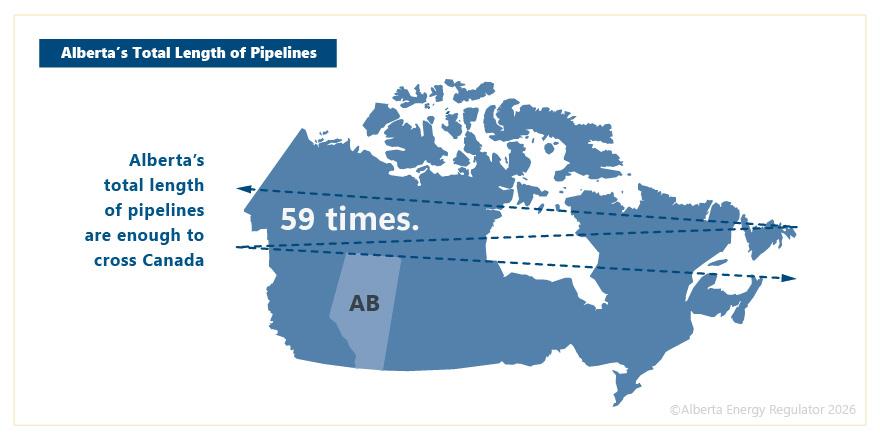
Pipelines are a safe, efficient, and reliable way of moving energy products over long distances. Alberta's total length of pipelines is 450 750 kilometres and growing, averaging about a 2% increase per year over the past five years.
As of 2025, the status of about 42% of AER-regulated pipelines was either discontinued or abandoned, an increase of about 16% over the past five years. Several factors may account for this increase:
- Companies are proactively replacing older lines with new pipelines to ensure pipeline integrity.
- Older reservoirs and oilfields are nearing the end of their lifespans.
- Pipelines are being discontinued or abandoned because of unfavourable production economics.
- The AER has implemented stronger liability management regulations that give companies credit for abandonment of unused infrastructure.
- Increased inspection focus on inactive pipelines and the inclusion of inactive pipelines in licensees’ integrity management programs.
Types of Pipelines
In 2025, Alberta's pipeline inventory transported various liquids and gases:
- 56% of the pipeline inventory carried natural gas
- 16% oil-well effluent
- 5% produced water
- 5% sour natural gas (natural gas with hydrogen sulphide concentrations greater than 1%)
- 5% fuel gas
- 5% crude oil
- 8% other substances, such as fresh water and sales-grade petroleum products
Pipelines are made from a variety of materials. About 85% of Alberta's pipelines are steel. The remaining 15% of pipelines are mostly polyethylene, fibreglass, or reinforced composite materials (i.e., nonmetallic materials) that are less susceptible to corrosion compared with steel.
Figure 2 shows a breakdown of the materials used for Alberta pipelines.
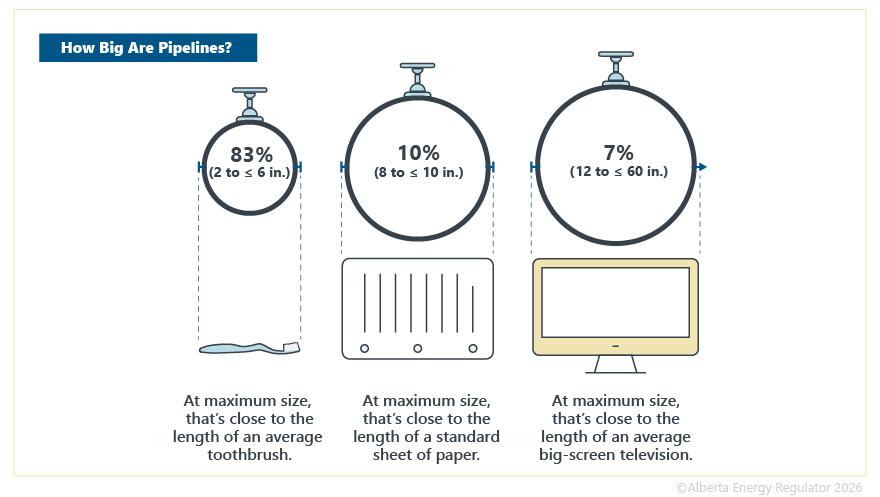
Most pipelines have a diameter of 6 inches or less (classified as nominal pipe size or NPS 6). These small-diameter pipelines carry production from individual wells to nearby processing facilities. Pipelines with 12-inch diameters or larger account for only 7% of the AER-regulated pipeline inventory.
Types of Operators
Most pipelines in Alberta are operated by companies that discover and produce oil and natural gas.
In 2025, 955 companies operated pipelines regulated by the AER. Over 80% of Alberta's pipelines are operated by 77 companies. Most companies (72%) operate less than 100 kilometres of pipeline.
Figure 3 shows the number of operators with pipelines of various lengths.
