November 2026
Under the industry performance program, we publish an annual Methane Performance Report. Here, we present reported data and data analysis demonstrating the progress in reducing upstream oil and gas methane emissions. In 2015, the Government of Alberta directed us to develop requirements to reduce methane emissions from upstream oil and gas operations. To accomplish this, requirements were developed in Directive 060: Upstream Petroleum Industry Flaring, Incinerating, and Venting and Directive 017: Measurement Requirements for Oil and Gas Operations. To learn more about these requirements, see our methane reduction page.
The methane emission reduction target established by the Government of Alberta was to achieve a 45% reduction in oil and gas methane emissions from a 2014 baseline by 2025. The new methane requirements set the oil and gas industry on the path toward achieving that target.
To evaluate the emission reductions achieved to date, we use a combination of reported information and modelling. Emission calculations are required for sources where reporting volumes are either incomplete or not submitted. Further information can be found in ST60B: Upstream Industry Emissions Report.
Alberta surpassed its methane reduction target of 45%, with modelled reductions indicating methane emissions have declined by approximately 62% from 2014 levels.
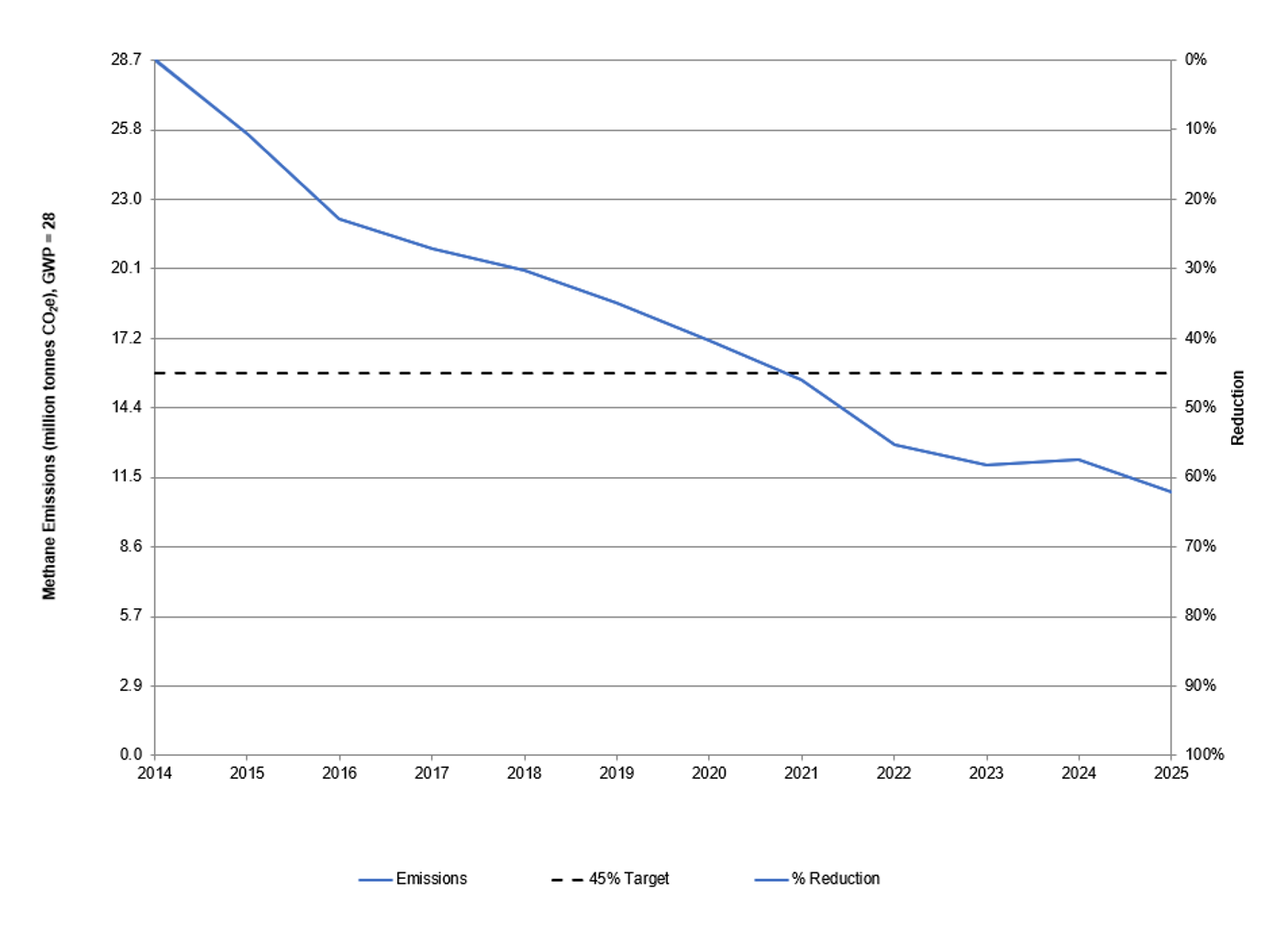
Most of the methane reductions shown here occurred before the Directive 060 methane requirements were in effect. These reductions resulted from improved industry practices and early action driven through programs like the Alberta Offset System, direct funding programs, and the methane reduction requirements.
Emissions modelling methodologies may differ from other parties. We will continue our compliance assurance activities and data quality assessments to improve our understanding of the 2014 emission baseline and the current methane emission levels. As data quality improves, we will continue our shift toward using reported data when possible, minimizing reliance on data estimation. We will evaluate emission reductions annually as part of our ongoing industry performance reporting.
Methane Intensity
Methane intensity provides a production-normalized measure of methane emissions and helps evaluate methane management performance. While there is currently no legislated methodology for calculating methane intensity, the AER uses the Natural Gas Sustainability Initiative (NGSI) Methane Emissions Intensity Protocol to provide additional context beyond total emissions volumes. This approach accounts for Alberta’s upstream production mix, including natural gas, crude oil, condensate, and crude bitumen.
Alberta’s methane intensity has declined overall since 2020, declining from 0.48% to 0.25% in 2025. The 2025 result represents a 0.04 point difference from 2024, when intensity was 0.29%. Over the same period, provincial oil, bitumen, and gas production continued to increase, indicating that methane emissions continued to decrease even as production grew.
The decline in methane intensity aligns with broader methane performance results. In 2025, Alberta’s methane emissions were estimated to be 62% below 2014 levels while achieving record-high solution gas conservation rates of 97.1% and reductions in both venting and flaring volumes. Together, these indicators show that methane performance improvements are occurring alongside continued resource development. Methane emissions for sources based on reported data decreased by 79%, while modelled sources increased by 17% from 2014 to 2025.
| Year | Methane intensity (%) |
|---|---|
| 2020 | 0.48 |
| 2021 | 0.41 |
| 2022 | 0.32 |
| 2023 | 0.29 |
| 2024 | 0.29 |
| 2025 | 0.25 |
Methane intensity calculated using the NGSI Methane Emissions Intensity Protocol and Alberta methane emissions inventory data. For more details, refer to ST60B.
