
November 2026
Liability refers to the legal responsibility to safely close and clean up energy development sites. The licensee has liability obligations regardless of the estimated cost throughout the energy development life cycle. The liability estimate is the estimated cost to meet these obligations. A liability estimate is calculated for a well or facility licence using the information outlined in Directive 011, which uses regional cost estimates or site-specific cost estimates conducted through site-specific liability assessments (SSLAs). The liability estimate comprises the estimated cost to complete both abandonment and reclamation activities of wells and facilities that are not reclaimed. How the AER estimates liability has changed over the last 20 years due to both changing operational practices and varying costs for closure work.
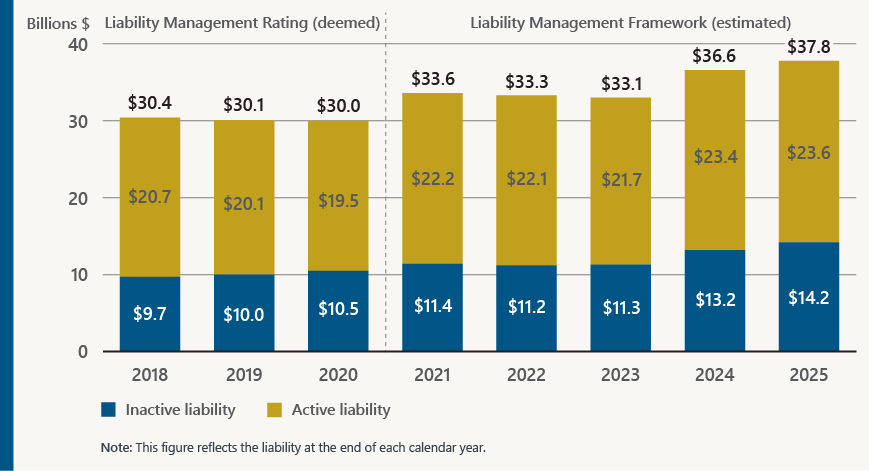
Liability estimates can be assessed in different ways, and the most common way is by “active” and “inactive” liability estimates. The life-cycle status of the infrastructure is used to determine active and inactive liability estimates. The total liability estimate is the sum of both active and inactive liability estimates. Figure 8 provides the total, active, and inactive liability. The information is shown as “deemed” liability or estimated liability. Historically, “deemed” liability was the liability used for the liability management rating (LMR), and the values in figure 8 correspond with previous LMR reports. In 2020, with the introduction of the new liability management framework, the AER began reviewing and updating its methodology to calculate the liability estimate. The increase to the liability estimate in 2021 was due to the inclusion of sweet multiwell batteries that had not been included previously.
Figure 8. Estimated Liability, 2018–2025
It is important to understand that the actual closure cost may not match the estimated cost. The actual amount spent is reported by licensees as closure spend, which we use to inform the regional costs listed in Directive 011. A liability estimate is assigned to a well, facility, or pipeline licence or approval based on Directive 011. When a closure activity is completed and reported to the AER (abandoned, decommissioned, or reclamation certified), the cost of that activity is now $0. The liability is then reduced by the estimated cost assigned to that closure activity from the most recent edition of the directive or the associated SSLA, not the amount actually spent.
Figure 8 presents 2018–2023 values based on the 2015 estimated costs in the previous version of Directive 011. Directive 011's regional well abandonment costs were updated in 2024 (see Bulletin 2024-16), and adjustments for groundwater protection and additional event sequences were updated in 2025 (see Bulletin 2025-04 and Bulletin 2025-26). The total oil and gas liability estimate is $38.0 billion at the end of 2025.
The liability estimate will adjust as we continue to update cost estimates for closure activities with licensee-submitted closure spend data. Currently, the AER is working on another update to cost parameters in Directive 011, which will be reflected in future reports.
Licensee Capability
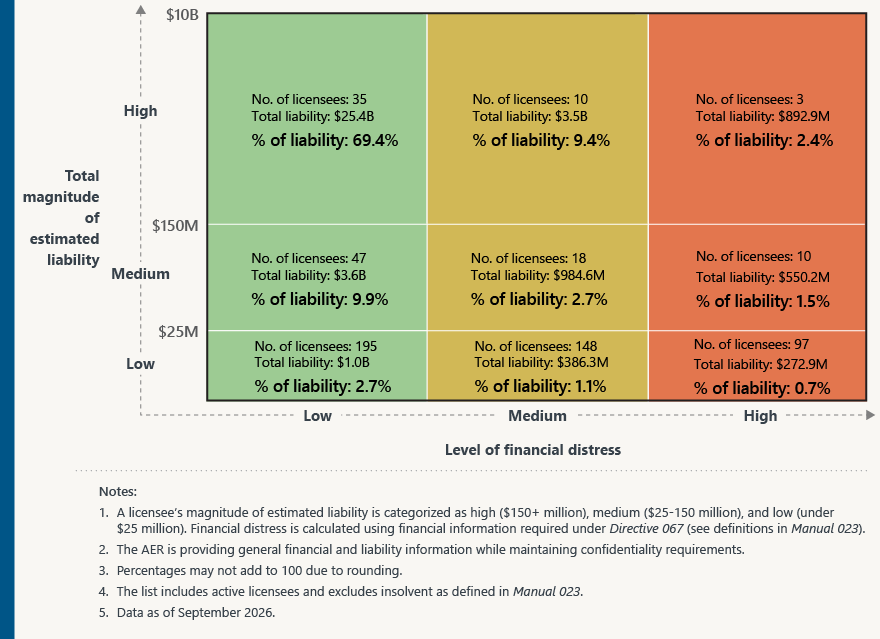
In addition to understanding liability, it is essential to understand whether companies can meet their regulatory and liability obligations throughout the energy development life cycle. To do this, we use a holistic licensee assessment (see Directive 088 and Manual 023 for details). Two important factors this assessment considers are a licensee’s total magnitude of estimated liability and their level of financial distress; figure 9 outlines the number of active licensees in each category. It highlights the percentage of total liability held by each group. Most of the estimated liability (82%) is held by licensees in low financial distress, whereas 5% of the total liability is held by licensees in high financial distress.
Figure 9. Licensee liability by magnitude of liability and level of financial distress
Transfers
Holistic licensee assessments are used in various regulatory processes. Specifically, when licensees want to buy or sell assets, they must submit a licence transfer application to the AER. When transfers are reviewed by the AER, the licensees involved are assessed using numerous factors, including their level of financial distress and the crossover timeline post-transfer (see Manual 023 for more information). Licensees presenting higher levels of risk are subject to greater scrutiny, which requires the collection of a security deposit. Table 1 summarizes transfer applications based on licensee capability.
When licences are transferred, the amount of security that is required depends on the inactive and marginal liability being transferred, and the financial capability and post-transfer crossover timeline of the transferee.
- Licences transferred to new licensees typically require some amount of security as new licensees do not have an established history with the AER and are considered a higher risk until the AER has more information on their capabilities and performance. In 2026, the AER implemented streamlined security requirements for new licensees, which will be reported in the 2026 performance report (see Manual 023).
- In 2025, most licence transfers were between existing licensees with similar financial capability and accounted for the transfer of ~$1.5 billion in inactive and marginal liability, due to several large acquisitions.
- In 2025, the highest percentage of security was collected where licences were transferred to less financially capable licensees because of the inactive and marginal liability transferred; this differs from 2024 where the highest percentage of this security was collected from new licensees.
Table 1. Transfer analysis by licensee capability, 2023 to 2025
| Year | Assets Transferred To | Well Count | Facility Count | Pipeline Count | Total Liability (millions) | Inactive Liability (millions) | Liability for marginal wells*(millions) | Security Collected (millions) | Security collected as a percent of inactive and marginal liability (%) |
|---|---|---|---|---|---|---|---|---|---|
| 2023 | To Equal Risk | 2 020 | 190 | 434 | $167.03 | $71.99 | $20.84 | $16.59 | 18% |
| To Less Capability | 341 | 95 | 168 | $46.53 | $16.80 | $3.73 | $0.48 | 2% | |
| To More Capability | 4 701 | 524 | 593 | $349.62 | $130.32 | $95.54 | $0.07 | 0% | |
| To New Companies | 6 974 | 619 | 925 | $576.52 | $142.19 | $100.07 | $25.69 | 11% | |
| 2024 | To Equal Risk | 2 373 | 278 | 414 | $159.02 | $72.13 | $14.24 | $2.61 | 3% |
| To Less Capability | 1 606 | 284 | 448 | $206.05 | $74.70 | $37.47 | $0.50 | 0% | |
| To More Capability | 1 757 | 133 | 126 | $80.09 | $25.21 | $11.53 | $0.20 | 1% | |
| To New Companies | 2 698 | 364 | 662 | $274.26 | $118.13 | $29.52 | $24.68 | 17% | |
| 2025 | To Equal Risk | 27 824 | 2 770 | 2 103 | $2 305.08 | $866.76 | $666.13 | $20.49 | 1% |
| To Less Capability | 125 | 19 | 40 | $13.29 | $7.63 | $0.64 | $2.17 | 26% | |
| To More Capability | 769 | 108 | 157 | $67.74 | $44.12 | $6.30 | $3.13 | 6% | |
| To New Companies | 1 929 | 282 | 455 | $204.31 | $71.28 | $42.55 | $7.42 | 7% |
Note: Licensee capability is determined through the holistic licensee assessment as part of the transfer application review and takes financial distress into consideration. New licensees are defined as having a new business associate (BA) code registered within the last three years. Data represented in this report may differ immaterially from previous years’ reports.
* “Marginal liability” only applies to wells and is a subset of active liability. See Directive 011 for definitions.
